
Thursday, 28 May 2015


Wednesday, 27 May 2015
tracheids and vessels
http://www.majordifferences.com/2013/03/difference-between-tracheids-and-vessels.html#.VWWtHsuJhy0
dear students
this site will give you difference between tracheids and vessels
dear students
this site will give you difference between tracheids and vessels
Tuesday, 26 May 2015
DIFFERENCE BETWEEN TRACHEIDS AND VESSELS
TRACHEIDS VESSELS
- It is present in all vascular plants - They are found mainly in angiosperms.
- They are comparatively short - They are usually long. May reach upto 2- 6 m.
- Each cell of tracheid is elongated with tapering ends.- Cells of vessel are placed one above the other
- The end walls remain intact - End walls are either absent or possess perforations.
- Cell cavities of tracheid are not much wide. - cell cavities or lumen are much wider.
- TRACHEIDS ARE NOT MUCH ELONGATED AS COMPARED TO FIBRES.
- THE CELL WALLS ARE NOT AS MUCH THICK AS COMPARED TO FIBRES
- LUMEN OF TRACHEID IS WIDE
- TRACHEIDS SERVE TO CONDUCT WATER AS WELL AS PROVIDE MECHANICAL SUPPORT.
FIBRES:
- FIBRES ARE ELONGATED
- FIBRES HAVE EXCESSIVELY THICK WALLS
- LUMEN OF FIBRES IS NARROW
- FIBRES ONLY PROVIDE MECHANICAL SUPPORT.
- CELLS ARE SMALL AND ISODIAMETRIC - VARIABLE IN SIZE
- INTERCELLULAR SPACES ARE USUALLY ABSENT - SPACES PRESENT
- VACUOLES ARE ABSENT - VACUOLES ARE PRESENT
- CELL WALLS ARE THIN - MAY BE THIN OR THICK
- CELLS CAN DIVIDE AGAIN AND AGAIN - DO NOT DIVIDE
- CELLS ARE UNDIFFERENTIATED - FULLY DIFFERENTIATED
- ITS A SIMPLE TISSUE. - MAY BE SIMPLE OR COMPLEX
IMPORTANT DIFFERENCES IN PLANT TISSUE CLASS IX
DIFFERENCES:
FIBRES SCLEREIDS
The main type of complex tissues are xylem and Phloem. Xylem is complex tissue and is also called Hydrome. This is responsible for the conduction of water in the plant. Cells of xylem are heterogenous in structure and function. Tracheids, vessels(tracheary elements), fibres and parenchyma are grouped together in xylem. Phloem is food conducting tissue. It is complex tissue, with sieve elements, companion cells, fibres and parenchyma.
1. Xylem is usually found deep in the plant
2. It conducts water or sap
3. In older plants, xylem often constitutes bulk of the plant body.
4. The conducting or tracheary cells are dead.
5. Xylem is made up of three types of dead cells (vessels, tracheids, xylem fibres)
6. There is one type of living cells (xylem parenchyma)
7. The conducting cells have lignin thickening in the wall.
8. Conducting elements are of two types: vessels and tracheids.
9. Tracheary elements have different types of wall thickenings.
10. Vessels are devoid of septa
11. Xylem provides mechanical strength.
Phloem
1. Xylem is usually situated towards the outer side of the plant.
2. It conducts organic food
3. Phloem always forms a small part of the plant body.
4. The conducting cells are living.
5. Phloem contains only one type of dead cells (phloem fibres).
6. There are three types of living cells (sieve tube cells, companion cells and phloem parenchyma)
7. Wall of sieve tube does not possess lignin.
8. Conducting elements are of one type: sieve tube.
9. Wall thickenings are absent in the conducting channels.
10. Sieve tubes have bulging and porous septa
11. Phloem has no mechanical function.
FIBRES SCLEREIDS
- Long cells with tapering ends. shorter in size
- the pits are less in number numerous pits
- fibres originate from meristematic cells. originate from parenchymatous cells by deposition of lignin
The main type of complex tissues are xylem and Phloem. Xylem is complex tissue and is also called Hydrome. This is responsible for the conduction of water in the plant. Cells of xylem are heterogenous in structure and function. Tracheids, vessels(tracheary elements), fibres and parenchyma are grouped together in xylem. Phloem is food conducting tissue. It is complex tissue, with sieve elements, companion cells, fibres and parenchyma.
Xylem vs Phloem
Xylem1. Xylem is usually found deep in the plant
2. It conducts water or sap
3. In older plants, xylem often constitutes bulk of the plant body.
4. The conducting or tracheary cells are dead.
5. Xylem is made up of three types of dead cells (vessels, tracheids, xylem fibres)
6. There is one type of living cells (xylem parenchyma)
7. The conducting cells have lignin thickening in the wall.
8. Conducting elements are of two types: vessels and tracheids.
9. Tracheary elements have different types of wall thickenings.
10. Vessels are devoid of septa
11. Xylem provides mechanical strength.
Phloem
1. Xylem is usually situated towards the outer side of the plant.
2. It conducts organic food
3. Phloem always forms a small part of the plant body.
4. The conducting cells are living.
5. Phloem contains only one type of dead cells (phloem fibres).
6. There are three types of living cells (sieve tube cells, companion cells and phloem parenchyma)
7. Wall of sieve tube does not possess lignin.
8. Conducting elements are of one type: sieve tube.
9. Wall thickenings are absent in the conducting channels.
10. Sieve tubes have bulging and porous septa
11. Phloem has no mechanical function.
functions of simple permanent tissues
FUNCTIONS OF PARENCHYMA

- STORAGE OF FOOD.
- PROVIDES TURGIDITY TO THE PLANTS AND MAINTAINS SHAPE .
- SLOW TRANSPORT OF VARIOUS MATERIALS THROUGH ITS CELLS
- SERVES AS PACKING TISSUE.
- WASTE PRODUCTS OF PLANTS ARE STORED IN THE PARENCHYMA CELLS.
- CHLORENCHYMA( PARENCHYMA CONTANING CHLOROPLAST) HELP PERFORM PHOTOSYNTHESIS.
- AERENCHYMA ENCLOSES LARGE SPACES IN AQUATIC ANIMALS FOR BUOYANCY AND EXCHANGE OF GASES.
- PREVENTS TEARING OF LEAVES.
- IT IS A MECHANICAL TISSUE AND PROVIDES BOTH MECHANICAL STRENGTH AND ELASTICITY.
- COLLENCHYMA CONTAINING CHLOROPLAST MANUFACTURES SUGAR AND STARCH.
- IT IS MAINLY MECHANICAL AND PROTECTIVE IN FUNCTION.
- IT PROVIDES STRENGTH , RIGIDITY , ELASTICITY AND HELP PLANTS WITHSTAND VARIOUS STRESSES AND STRAINS.
- THESE FIBRES ARE USED IN MANUFACTURE OF ROPES AND MATS AND CERTAIN TEXTILE FIBRES.
Characteristics of meristematic tissues
MERISTEMATIC TISSUE
It comprises of group of similar and immature cells. the main characteristics are:
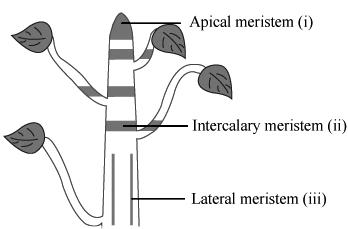
It comprises of group of similar and immature cells. the main characteristics are:
- cells are small and thin walled.
- cells are closely packed together without intercellular spaces.
- cells may be round, oval or polygonal.
- vacuoles are absent or very small.
- cells have dense cytoplasm.
- Cells keep on dividing and produce new cells.
- APICAL : elongation of roots and stems.
- INTERCALARY: elongation of an organ
- LATERAL: increasing diameter and girth of plant.
Subscribe to:
Posts (Atom)